Table of Contents
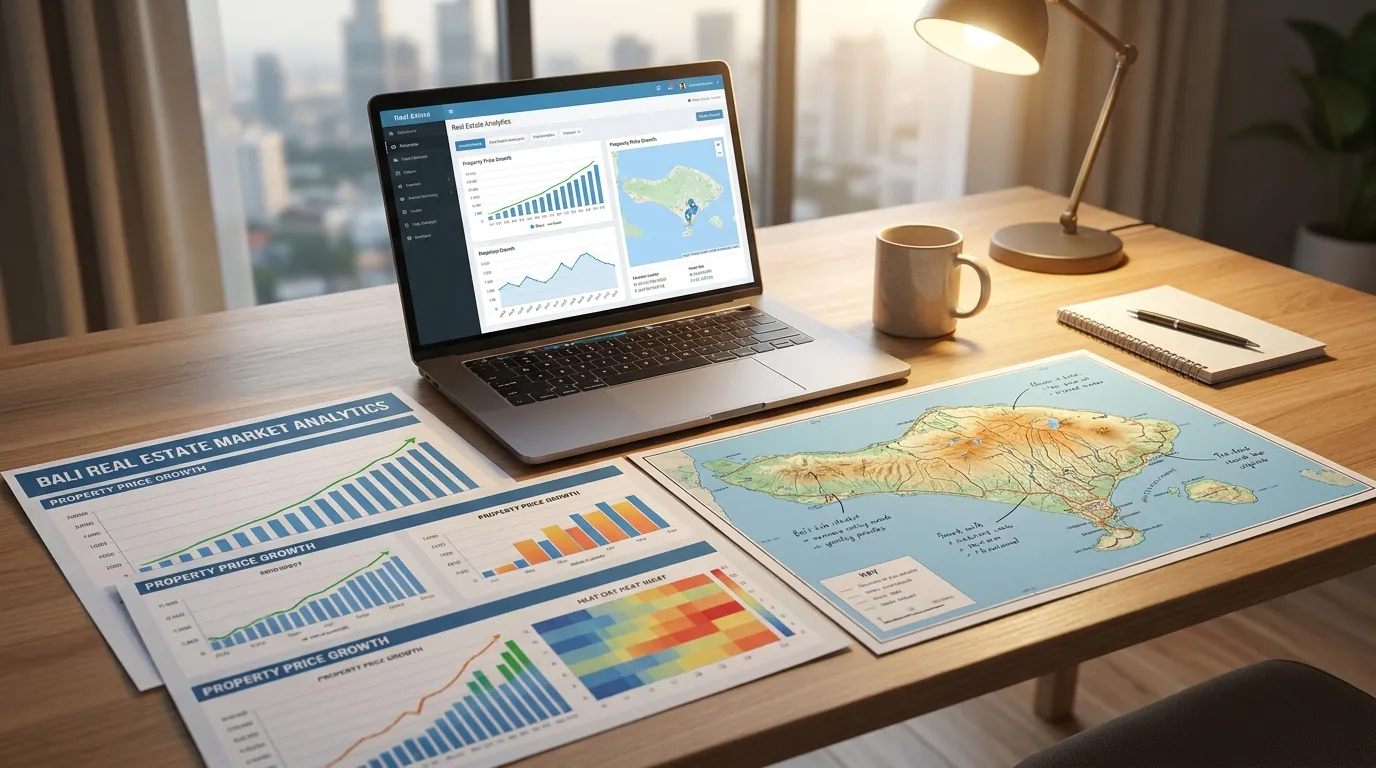
The price gap between building your own villa and buying a ready-built unit in Bali averages 25–40% of the asset value. On a 3-bedroom villa worth IDR 6 billion, that is IDR 1.5–2.4 billion — the difference between recouping your investment in 5 years versus 9. This article breaks down the real cost to build a villa in Bali per square meter, what a Bill of Quantities (RAB) actually contains, the hidden developer margin, and the precise break-even point between building and buying ready.
Cost to Build a Villa in Bali per Square Meter
As of 2026, villa construction costs in Bali sit in an indicative range of IDR 9 million to IDR 28 million per square meter, depending on the specification tier. These figures cover net build cost only (structure + finishing + MEP) and exclude land, PBG permit fees, and furniture (FF&E). The spread between tiers is driven by material quality, design complexity, and finishing level.
The Three Villa Build-Cost Tiers
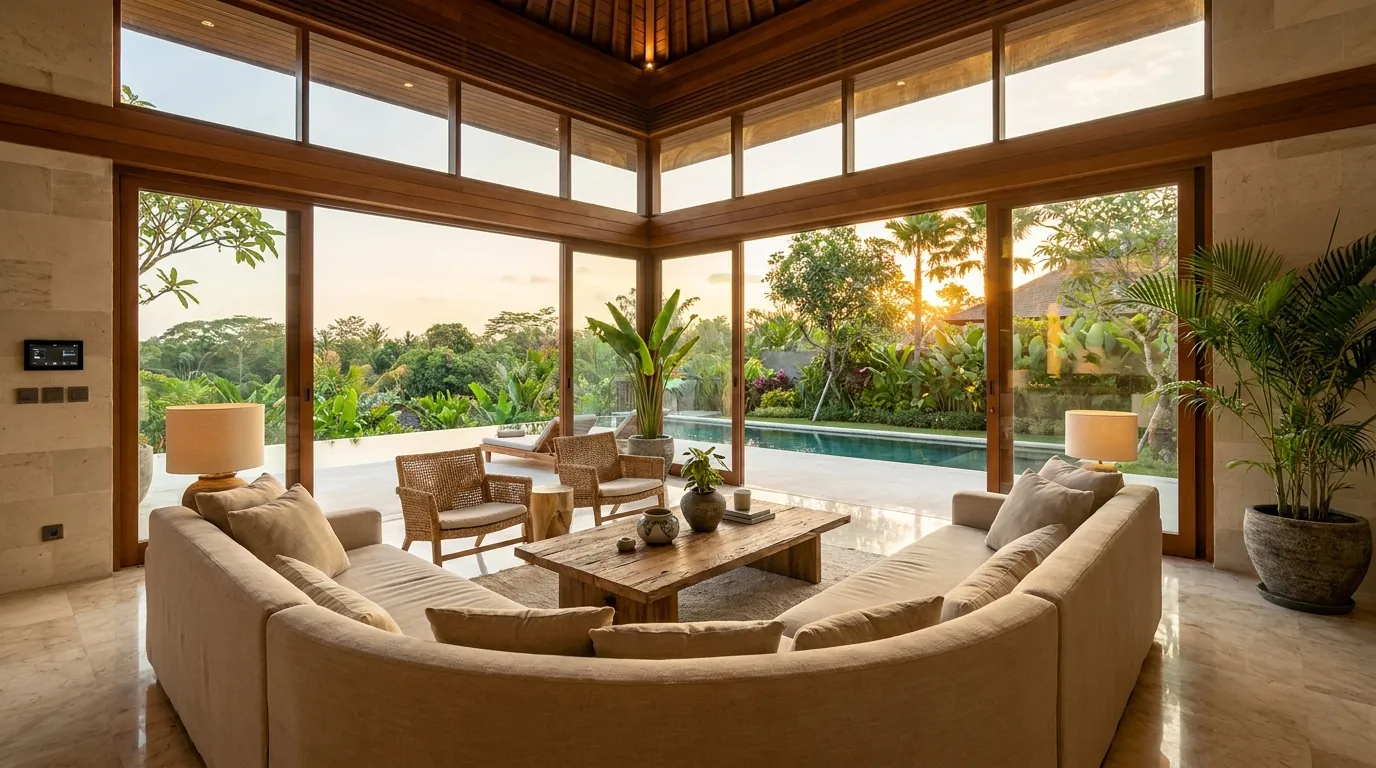
Most owners from Jakarta targeting the premium rental market choose the eco-luxury tier, because the nightly rate of an enclosed, air-conditioned villa with smart home far exceeds that of a standard open-plan unit. Here is how the cost to build a villa in Bali per square meter compares across tiers:
| Specification Tier | Cost per m² | Materials & Finishing | Rental Profile |
|---|---|---|---|
| Standard | IDR 9–12M | Lightweight brick, ceramic floors, standard aluminium frames, tile roof | Monthly / long-stay |
| Premium | IDR 13–18M | Local natural stone/marble floors, solid wood, tempered glass, pool | Daily (Airbnb) |
| Eco-Luxury | IDR 19–28M | Imported marble, teak, anti-UV double glazing, smart home, full AC, tropical landscaping | Premium daily / branded |
For illustration, a 3-bedroom villa with 200 m² of built area at the eco-luxury tier (assuming IDR 22M/m²) produces a construction cost of roughly IDR 4.4 billion, excluding land and furniture. A trusted Bali villa contractor will lock this figure into a lump-sum contract so you are protected against cost overruns as the project proceeds.
It is important to understand that the cost to build a villa in Bali per square meter is not linear. A small 100 m² villa tends to cost 10–15% more per m² than a 250 m² villa, because fixed items such as permits, the pool, the kitchen, and utility connections are spread over a smaller built area. Conversely, a design with many corners, stepped roofs, and wide glass openings raises the per-m² cost by adding execution complexity. As a result, two villas of identical area can have RABs that differ by hundreds of millions of rupiah purely because of shape and finishing level.
Components Beyond the Per-Meter Build Cost
Many first-time owners mistakenly equate total investment with the per-m² figure multiplied by area. In reality, significant items sit on top of construction cost: the land price (the largest variable, IDR 0.8–3 billion per are depending on location), PBG permit and consultant fees (1–3% of build value), furniture and FF&E (IDR 0.4–0.8 billion for a 3-bedroom villa), plus landscaping and perimeter walls. Ignoring these items is the leading cause of projects running out of cash at the finishing stage — the most vulnerable moment for an owner managing remotely.
Important: Be wary of "IDR 6M/m²" offers. A price that low usually cuts foundation quality, slab thickness, and waterproofing — precisely the items that are most expensive to repair once a villa stands in Bali's humid coastal climate.
What an RAB Contains: Where Your Money Goes
A transparent RAB (Bill of Quantities) is your single best protection against stalled projects and hidden costs. A professional villa construction RAB breaks the total cost into measurable line items, complete with quantities (m², m³, units) and unit prices. The typical budget distribution of an eco-luxury villa is roughly as follows:
- Site preparation & foundation (12–18%) — clearing, excavation, bore/strauss piles, ground beams. This item spikes on contoured or rocky land.
- Structure (18–22%) — reinforced-concrete columns, beams, slabs, stairs.
- Architecture & finishing (25–30%) — walls, floors, ceilings, paint, frames, doors, windows — the largest item and the one that defines the sense of luxury.
- MEP (12–16%) — mechanical, electrical, plumbing, AC, and smart-home wiring.
- Pool & landscaping (8–12%) — pool, decking, tropical garden, irrigation.
- Contingency (3–5%) — reserve for unforeseen site conditions.
- Contractor & project management fee (8–12%) — supervision, safety, and quality assurance.
Without a detailed RAB, it is impossible to detect whether a contractor is inflating unit prices or reducing material volumes. This is exactly why the benefit of building your own villa is so large versus buying ready: you control every rupiah at the line-item level rather than accepting a final price with no breakdown.
A good RAB is also the basis for a milestone-based payment schedule. Instead of paying upfront, funds are released in stages tied to verified progress — for example 20% on foundation completion, 25% when the upper structure stands, and so on. This scheme aligns your interests with the contractor's and forms the primary safeguard against stalled-project risk, which is the most common nightmare for owners in Jakarta who cannot inspect the site daily.
Free 3BR Villa Excel Financial Model
Get our Excel financial-model template for a 3-bedroom villa: full RAB, ROI simulation, and a break-even calculator. Or run the numbers instantly with our villa calculator.
Request Template via WhatsAppWhy Ready-Built Villas Cost 30–40% More
Ready-built villa prices in Bali typically carry a developer margin of 30–40% over the real construction cost. This margin is not pure profit; it covers marketing, agent commissions (5–8%), the cost of capital during construction, developer risk, and often a speculative markup on rising land values. When you buy a finished villa, you pay for all of these components at once.
To illustrate: a villa whose land + build cost is IDR 4.5 billion is commonly marketed by developers in the IDR 6–6.3 billion range. That IDR 1.5–1.8 billion gap is what you save by building yourself through a trusted Bali villa contractor. The added benefit: you choose the location, design, and specification tier to fit your rental strategy — rather than accepting a mass-market product engineered for the developer's margin, not the owner's yield.
There is also a quality dimension that often goes unnoticed. Because developers market villas on visual appeal, cost savings are frequently hidden in items the buyer never sees: slab thickness, concrete grade, waterproofing quality, and electrical installation. When you build yourself with a transparent RAB and independent supervision, you set the quality standard for these hidden items — an investment that pays back as dramatically lower maintenance costs over the villa's first 10 years of operation.
Build vs Buy Ready: The Property Break-Even Table
The advantage of building yourself is not only the upfront price gap, but how much faster that gap shortens the break-even point of the investment. The table below compares two identical eco-luxury 3-bedroom villa scenarios, assuming an estimated net villa rental income of IDR 600M/year (occupancy ~65%, premium ADR):
| Component | Build Yourself | Buy Ready-Built |
|---|---|---|
| Land (3 are) | IDR 2.4B | Included in price |
| Build cost (200 m² @ IDR 22M) | IDR 4.4B | Included in price |
| Furniture (FF&E) | IDR 0.5B | Included in price |
| Total investment | IDR 7.3B | IDR 9.8B |
| Net rental income / year | IDR 600M | IDR 600M |
| Annual ROI (yield) | ~8.2% | ~6.1% |
| Break-even point | ~12.2 years | ~16.3 years |
The IDR 2.5 billion difference in total investment shortens the break-even point by nearly 4 years and lifts the yield by more than 2 percentage points. If the upfront saving is reallocated to build a second villa, the compounding effect on your rental portfolio is far larger still. This is the financial logic behind why experienced owners from Jakarta almost always choose to build.
Tip: Calculate the break-even point using net rental income (after management, OTA fees, utilities, and tax) — not gross. Many developer projections use gross figures, making the BEP look far faster than reality.
Foundation Note: Limestone Rock Strata in Uluwatu
Foundation cost can deviate significantly from the average depending on ground conditions — and this is highly relevant in South Bali. The clifftop plots in Uluwatu and surroundings rest on hard limestone rock strata that require rock breakers and specialized foundation techniques, so the foundation line can rise 20–35% versus flat land in Pererenan or Seseh.
Conversely, stable limestone eliminates the need for deep pile foundations, which are themselves expensive on the soft soils near the beach. For that reason, a soil test (sondir) is mandatory before the final RAB is locked. An accurate cost to build a villa in Bali per square meter is only possible once your site's ground character is known — generalizing per m² without a survey is the number-one source of cost overruns.
RAB Consultation & Build-Cost Estimate for Your Villa
Send us your location and villa concept. Our team prepares a per-meter cost estimate and an initial RAB framework — free, with no commitment.
Request an Estimate via WhatsAppConclusion
Building a villa in Bali requires more patient upfront capital, but mathematically it almost always outperforms buying a ready-built unit: you erase the 30–40% developer margin, shorten the break-even point by up to 4 years, and lift yield by more than 2 points. The keys are a transparent RAB, a proper soil survey, and a contractor who locks the price in a lump-sum contract. With those three foundations, the "cost to build a villa in Bali per square meter" turns from a source of anxiety into a competitive edge for your portfolio.