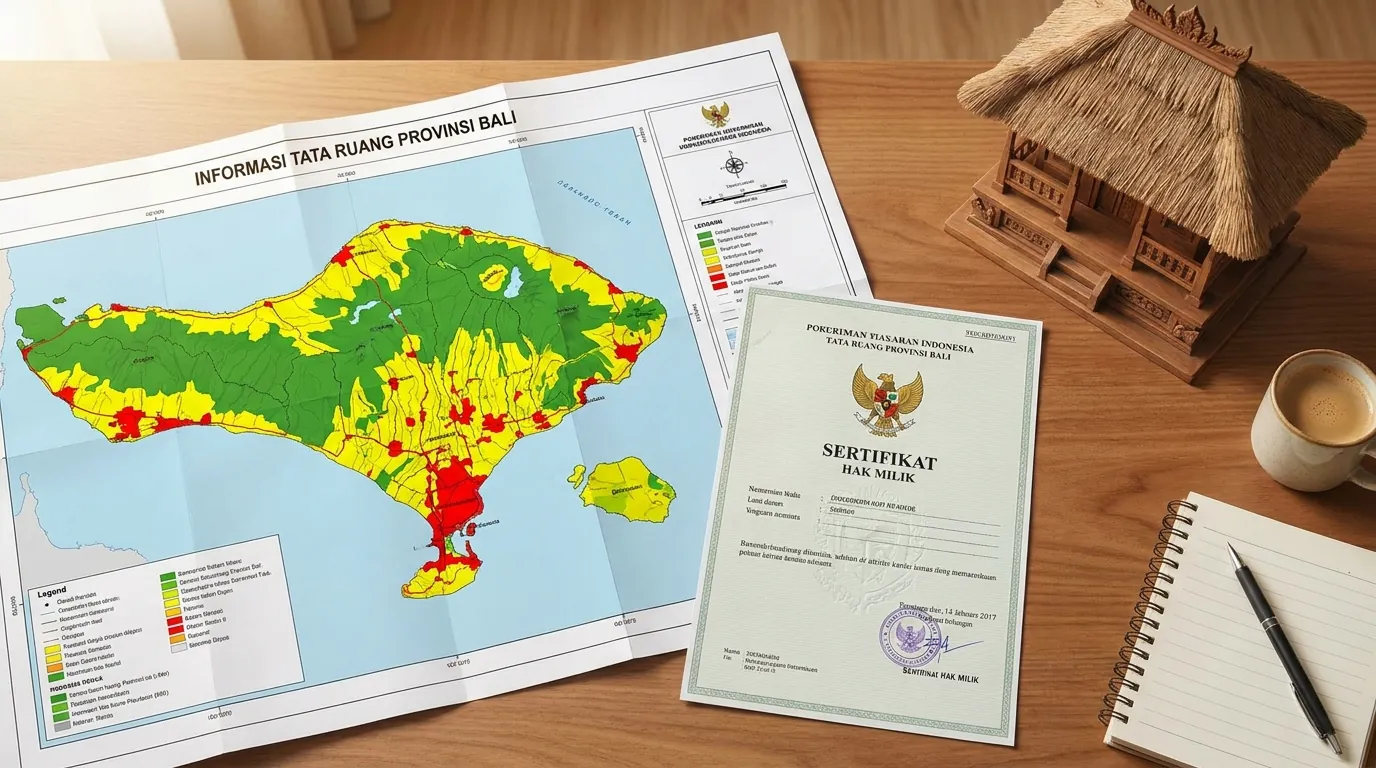
The total tax burden for building a house in Bali as an Indonesian citizen runs 7–9% of the project value — a figure routinely missing from Jakarta investors' budgets. On a Rp 7 billion project (Rp 3 B land + Rp 4 B build), tax and legal obligations can exceed Rp 250–300 million before a single brick is permanently laid. This article breaks down every component — BPHTB, self-build VAT, PBB, and notary fees — with current rates and a full worked example for 2026 planning.
Understanding this tax structure is not a formality. The gap between disciplined planning and improvisation can reach tens of millions of rupiah, particularly around the NPOP base and the self-build VAT threshold. Here is the breakdown in transaction order.
BPHTB 5%: The First Tax When Buying Land
BPHTB (the land and building acquisition duty) is the first tax the buyer must settle, charged at a flat 5% across Indonesia, including every regency in Bali. The taxable base is the Acquisition Value of the Tax Object (NPOP) — the transaction price or the assessed NJOP, whichever is higher — minus the non-taxable threshold (NPOPTKP).
How to Calculate NPOP and the Bali NPOPTKP
The NPOPTKP in the Badung, Gianyar, and Denpasar regencies is generally set at around Rp 60 million per acquisition. So for land with an NPOP of Rp 3 billion, the taxable base becomes Rp 2.94 billion and the BPHTB due is Rp 147 million. Many buyers mistakenly record an NPOP on the deed below the real price to reduce BPHTB — a risky practice, since the Tax Office can verify the NJOP, correct it upward, and impose penalties.
Key note: BPHTB must be paid in full before the land deed official (PPAT) signs the Sale and Purchase Deed. Without proof of BPHTB payment, the Hak Milik title transfer cannot be processed at the Land Office. Budget this cost up front, not at the end.
Self-Build VAT (PPN KMS) Explained
When you build a villa without engaging a VAT-registered developer who issues full tax invoices, Self-Build VAT (PPN KMS) applies. The effective rate is 2.2% — derived from a 20% taxable base multiplied by the 11% VAT rate — calculated on total construction cost excluding the land price.
The 200 m² Threshold and How PPN KMS Is Paid
Self-Build VAT applies only to buildings with a floor area of at least 200 m². Villas below that size are exempt. For qualifying buildings, the VAT is paid in monthly installments throughout construction, calculated on the actual cost incurred each month and reported by the end of the following month. On a Rp 4 billion build, total self-build VAT reaches around Rp 88 million.
An Accurate Tax Audit for Your Project
Send us your land size, location, and estimated build cost. Our team prepares a full BPHTB, self-build VAT, and PBB projection within one business day — or run the numbers yourself in our villa tax calculator.
Request a Tax Audit via WhatsAppNotary/PPAT Fees & Title Transfer
Notary/PPAT fees for preparing the Sale and Purchase Deed, certificate checks, and the Hak Milik title transfer generally run 1% of the transaction value, negotiable on larger deals. For Rp 3 billion in land, budget around Rp 30 million. This component is separate from taxes and can often be split between seller and buyer by agreement.
Additional Components in Notary Land-Purchase Fees
- Land registration state fee (PNBP) — the government charge for the rights transfer at the Land Office, relatively small.
- Certificate authenticity & zoning check — verifying the Hak Milik is free of disputes and sits in a yellow (residential) zone, not green agricultural land.
- Tax validation — the PPAT confirms the seller's income tax (2.5%) and buyer's BPHTB are paid before the deed is signed.
PBB: The Annual Tax of Owning a Home in Bali
Once the villa is built, the recurring Bali property tax is PBB (Land and Building Tax), levied annually at 0.1%–0.2% of the NJOP for the combined land and building. For a property worth about Rp 7 billion, annual PBB runs from Rp 7 million to Rp 14 million — small relative to the asset value, but it must be paid on time to keep the title clean for any future resale.
For Jakarta–Bali property investors who rent out their villa, rental income is subject to a final income tax of 10% of gross rent. This is separate from PBB and an important factor when calculating net yield.
Worked Example: Rp 3 B Land + Rp 4 B Build
Below is the tax and legal cost breakdown for a typical scenario: purchasing Rp 3 billion of Hak Milik land and building a 250 m² villa worth Rp 4 billion in the Badung area. Figures are indicative estimates for 2026 planning.
| Component | Taxable Base | Rate | Estimate (Rp) |
|---|---|---|---|
| BPHTB | (Rp 3 B − Rp 60 M NPOPTKP) | 5% | 147,000,000 |
| Notary/PPAT fees | Rp 3 B (land transaction) | ±1% | 30,000,000 |
| Self-Build VAT (PPN KMS) | Rp 4 B (build cost, ≥200 m²) | 2.2% | 88,000,000 |
| Total one-time cost | — | — | 265,000,000 |
| PBB (annual) | NJOP ±Rp 7 B | 0.1%–0.2% | 7,000,000–14,000,000 |
With a one-time cost of roughly Rp 265 million — about 3.8% of the Rp 7 billion project value — plus annual PBB, it is clear that taxes belong in the budget (RAB) from day one, not treated as a surprise expense at the end.
Legal Tax Optimization
Legitimate tax savings come from correct recording and structure choice, not value manipulation. Three legal optimization steps relevant to citizens:
- Separate land price from construction cost. Self-build VAT applies only to the build, not the land. RAB documentation that clearly splits the two prevents overstating the tax base.
- Use a VAT-registered contractor. If the build is carried out by a VAT-registered (PKP) contractor issuing full 11% VAT invoices, the self-build VAT obligation falls away — you pay VAT through the contractor's invoices rather than self-reporting, keeping the administration cleaner.
- Ensure the seller's income tax is paid before the deed. As the buyer, do not quietly absorb the seller's 2.5% income tax. Agree on how transaction costs are split in writing from the start of negotiations.
Tip: If the building's floor area is close to the 200 m² threshold, careful design planning can determine whether self-build VAT applies at all. Discuss the trade-off between floor area and VAT burden with your contractor at the floor-plan stage.
Plan Your Villa Taxes Properly
JasaBangunVilla manages the full cycle — from certificate checks to monthly self-build VAT remittance — so there are no tax surprises. Discuss your project with us today.
Tax Consultation via WhatsAppConclusion
Construction and ownership taxes in Bali for citizens comprise four main components: 5% BPHTB on the land purchase, ~1% notary fees, 2.2% self-build VAT for buildings ≥200 m², and annual PBB of 0.1%–0.2%. On a Rp 7 billion project, the total one-time cost is around Rp 265 million. By building these figures into the budget from the outset and using the right legal structure, Jakarta investors can build a villa in Bali with no fiscal surprises — and on a clean ownership footing for the future.